
BIM, specialist models and AR
Digital building models and construction-related information are intended to provide a verifiable basis for actual execution.
Becht 4.0 is my closed technological ecosystem built from my own developments in products, testing, tools, calculation and modelling. It combines BIM, AR and intelligent manufacturing with my own mathematical models for the digital twin, across all trades and the entire service life of a building.
An integrated technological concept and development work—not a claim that all functions are already fully implemented or approved by building authorities.
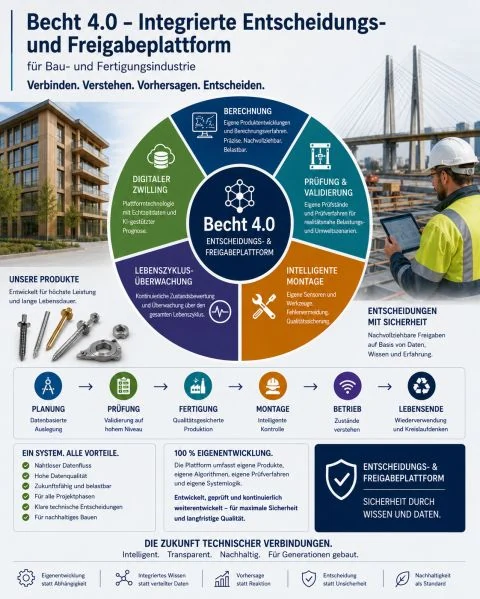
“The construction industry does not lack data.
It lacks reliable technical decisions.”
Technical safety requires linked information from real construction and manufacturing practice, not just isolated models, sensors or documents.
The architect’s design, the structural engineer’s calculations, actual production, installation and subsequent operation are technically connected. In practice, information is often kept separately. When conditions change years later, the links between individual data sets are often missing.
My approach extends far beyond fasteners: walls, roofs, load-bearing structures, construction materials, surfaces and coatings are part of the life cycle, as are manufacturing, installation, dynamic loading, ageing and the technical condition after fire damage.
Becht 4.0 is intended to connect these levels and thereby enable continuous technical assessment: What was planned? What was actually manufactured? What was installed? What has changed? What technical decision is required?
With traceable planning, execution, testing, condition and life-cycle information, together with my mathematical evaluation logic, digital twin and AI-assisted analysis.
Every technical level affects the next. The ecosystem is designed to link the information across all construction trades.
Becht 4.0 is not merely another stand-alone software product. Its technological layers are intended to work together.
Digital building models and construction-related information are intended to provide a verifiable basis for actual execution.
Connected tools are intended to compare planned requirements with actual manufacturing and installation, and record completed work.
My VDK-WP and AntiFire developments link testing of materials, components, surfaces, coatings and fasteners with real loads.
I conceived my own digital twin on the basis of mathematical models I developed myself. It combines actual testing and condition data with calculations over time.
My own mathematical models and AI are used to systematically evaluate measured conditions, dynamic loading, ageing and predicted remaining service life.
Technical decisions should be traceable, justifiable and permanently documented.
I developed the mathematical core of my digital twin myself. My models link test data, dynamic loads, changes in materials and conditions with the calculation-based evaluation of long-term behaviour.
They are intended to make the condition of the entire building, its components, surfaces, coatings and fasteners assessable throughout use, and to predict changes. Remaining service-life assessment after exposure to fire is also part of my development approach.
A central development goal is to compare the planned and approved model with actual construction. This includes not only geometric deviations but also the components and fasteners used, the installation steps carried out and the technical boundary conditions.
This description outlines the intended operating principle; specific technical implementations are not disclosed.
Becht 4.0 is conceived for companies, professionals and institutions throughout the entire life cycle.
Relate models, calculations and requirements to the work actually executed.
Record automated production and specific component data as part of a building’s history.
Guide execution clearly, detect deviations and trace installation steps.
Assess the technical condition and its changes throughout the entire service life.
Review verifiable documentation and the technical basis for decisions.
Use stored building and condition information for a technical analysis of causes.
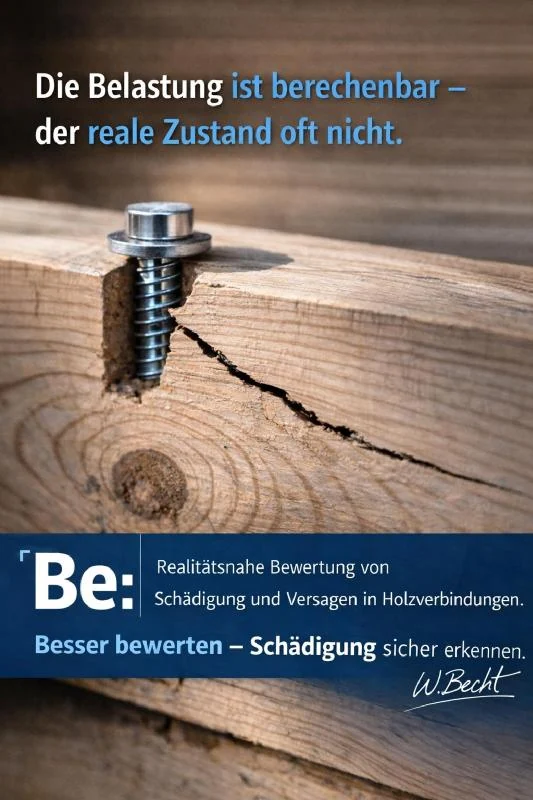
A damage pattern alone does not automatically explain its cause. Only the combination of design, manufacturing, installation, testing, use and actual condition can help reconstruct technical relationships.
Becht 4.0 is designed to bring this information together over the long term so that changes can be detected and potential causes investigated systematically. This supports expert assessments but does not replace the required technical or legal examination.
No. The ecosystem is intended for the entire construction and manufacturing industry. The proprietary developments in timber and hybrid construction are important technical starting points but do not limit the intended scope.
No. The approach is a closed, integrated technical ecosystem consisting of proprietary developments, testing procedures, intelligent tools, digital models, AI and traceable technical decision-making and approval logic.
BIM provides important planned building information. AR can make information visible for actual execution and checking. Becht 4.0 is intended to connect these layers with actual manufacturing and installation.
Becht 4.0 is designed to prevent errors starting in the planning phase. Planned and approved specifications are compared with manufacturing and installation. The system is intended to flag deviations and block unapproved steps through intelligent tools. Complete documentation additionally supports later root-cause analysis.
Waldemar Becht · TEDWALDI® · Research, testing technology and connection technologies. Write to me directly, preferably with a brief description of your subject.
WhatsApp exclusively for written messages. No invitation to call by phone.